
White Balance in Food Photography - White Balance

White balance in food photography is based on the same principles as basic photography.

Light consists of different wavelengths. Our eyes perceive wavelengths between red and violet. Light sources are divided into natural and artificial light sources. While what we mean by natural light is daylight, artificial light sources are the lights produced by humans. When we shine colored light on a white object, the object or object is seen in the color tones of that light. Light sources or objects with different colors and tones have different color temperatures. This heat or coldness is measured in degrees Kelvin. It has a scale between 2000-10000K,
Sunlight (5500K) is the light source that provides the most natural appearance of these objects or objects, while unnatural light sources have different color temperatures. Our eyes continue to perceive objects with their natural colors by adapting to different light conditions, but digital cameras have a system called white balance for this. The white balance setting helps record colors as we see them, corrects color changes that may occur from various light sources in the environment, and helps white tones appear as 'white'.
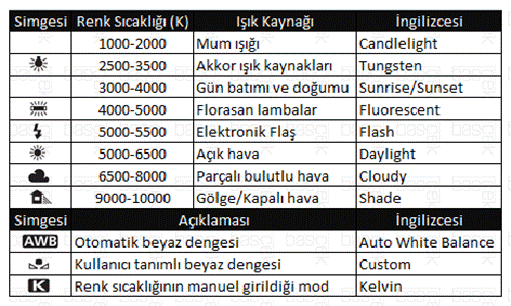

In the table above, you can see the preset white balance icons on the camera and the color temperature values of their corresponding light sources. The AWB (Automatic White Balance) option is available on most cameras and selects the correct white balance in most cases. Therefore, if you are not sure what light conditions you are in, you can shoot in RAW format with the AWB setting and then adjust the white balance in your preferred editing software
In this setting, our camera evaluates the color balance in the frame and makes the best decision for us. We obtain accurate results especially at values of 3000-7000 Kelvin. However, it is not possible to obtain accurate results in low light or unusual conditions and we may need to make the settings ourselves.
Cloudy: In cloudy weather, the Kelvin value is between 6000-7000 K. At these values, the color temperature is high. That's why we may need to set our white balance to cloudy.
Daylight: It is the setting used outdoors at 5500 Kelvin (K0) values under normal conditions, that is, in daylight. Kelvin (K0) at sunrise and sunset. values 4000K. Our photos appear in warmer tones when taken in the morning and evening hours in daylight setting.
Fluorescent: In this mode, which we will choose in environments where fluorescent lamps are used, the white balance is generally between 4000-5000 Kelvin, so we get a photographic temperature with blue tones.
Yellow Lamp: (Tungsten): When we shoot at this setting, we see that our photos have yellow-orange color deviation. This is because the Kelvin value of tungsten light is in the range of 3200-3400K. If we shoot in daylight with the tungsten setting, blue tones will still dominate our photographs.
Flash: – This is the mode in which the camera adjusts the white balance according to the flash usage status.
User defined / (Custom): – If you are in a very complex lighting environment, you show the camera which color is white and the photo determines a temperature scale according to your choice. For example, in a very cold environment, a white value of 10,000 K that the camera perceives may actually be 5500 K. In this setting, you do a kind of neutralization and adjust the white balance of your photo accordingly.
Kelvin:This mode, which allows you to choose the Kelvin value yourself, is generally used by intermediate or professional photographers.


Comments